

Clinical Validation
Clinical validation is the process of testing a device to ensure that it safe, effective, and performs as intended. This generates evidence based on accepted clinical criteria to demonstrate that the device meets clinical standards in real-world medical settings.
While many products claim to be 'Clinically Validated', it is important that validation studies are conducted using modern protocols, independently verified for accuracy, and that the findings are published in a peer-reviewed journal.
Published validation studies of DigiVis DVA
 |
Clinical validation of a novel web-application for remote assessment of distance
visual acuity.
Thirunavukarasu AJ, Mullinger D, Rufus-Toye RM, Farrell S, Allen LE. Eye(Lond) 2021. The accuracy of the DigiVis Online prototype was compared to gold-standard clinician tested Visual Acuity in 120 eye clinic patients due to have follow up face-to-face consultations. The mean difference was insignificant with limits of agreement (LOA) of ± 0.17 and test-retest variability (TRV) LOA ±0.12 logMAR. 95% of this cohort said they would be willing and able to use DigiVis Online at home for future use. |
 |
Novel web application for self assessment of distance visual acuity to support remote consultation: a real-world validation study in children.
Allen L, Thirunavukarasu AJ, Podgorski S, Mullinger D. BMJ Open Ophthalmol 2021; 6(1). A study in 89 children aged 4-10 using the child version of the DigiVis Online prototype found an insignificant difference in VA measurement with LOA of ±0.19 logMAR and TRV LOA of ±0.18 logMAR. The gold standard TRV LOA in adults is ±0.15 logMAR. 96% of the children rated the test good or excellent, as did 97% of their parents. |
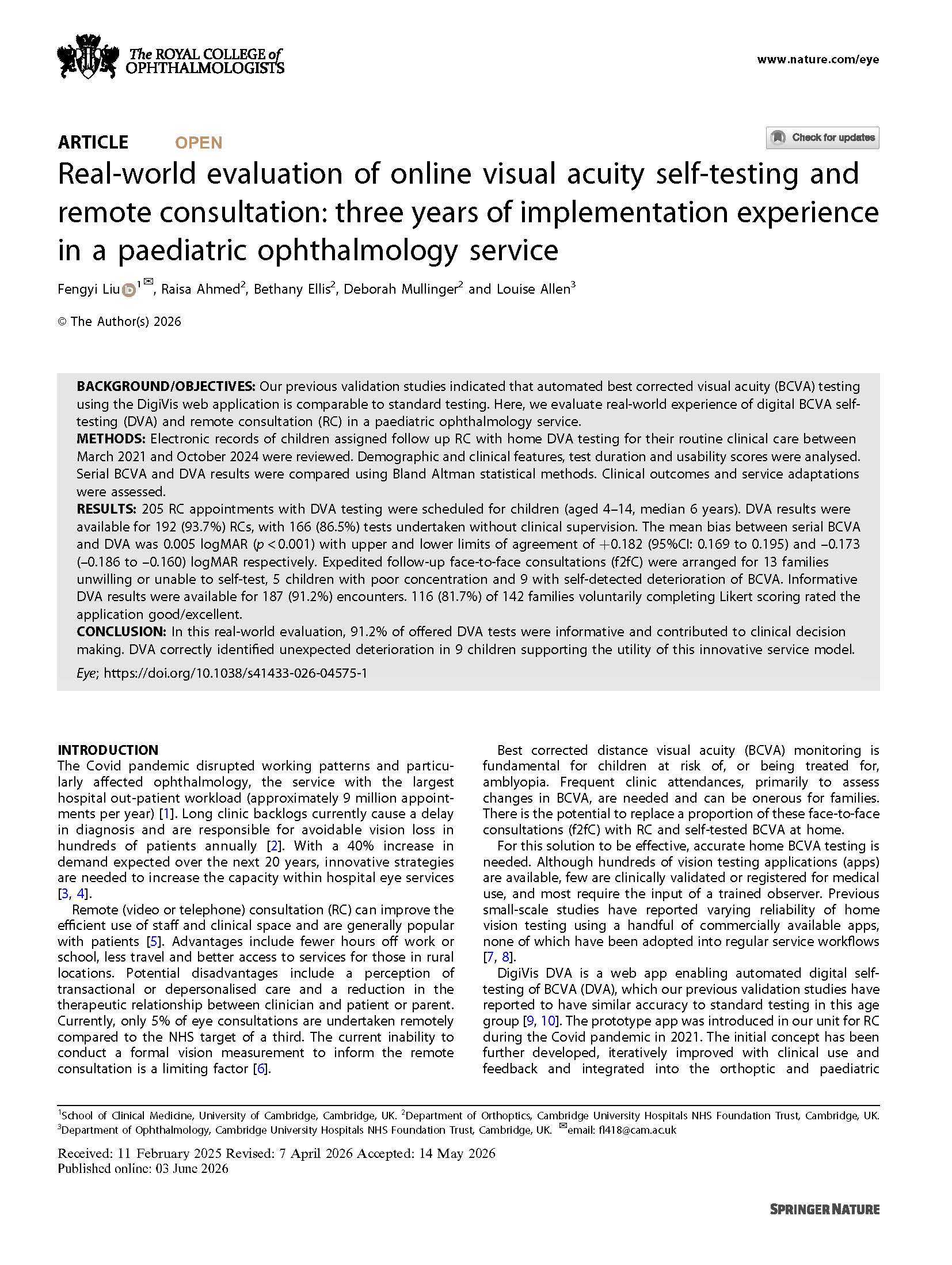 |
Real-world evaluation of online visual acuity self-testing and remote consultation:
three years of implementation experience in a paediatric ophthalmology service.
Liu F, Ahmed R, Ellis B, Mullinger D, Allen L. Eye 2026 (online). Previous validation studies indicated that automated best corrected visual acuity (BCVA) testing using the DigiVis DVA web application is comparable to standard testing. This evaluation of real-world experience of digital BCVA self-testing (DVA) and remote consultation (RC) in a paediatric ophthalmology service found that 91.2% of offered DVA tests were informative and contributed to clinical decision making. DVA correctly identified unexpected deterioration in 9 children, supporting the utility of this innovative service model. |
Presentations and interim data for DigiVis DVA
|
Clinical validation of a web-app for
remote visual acuity assessment
Thirunavukarasu AJ, Mullinger D, Farrell S, Allen LE Poster: RCOphth Congress 2023 |
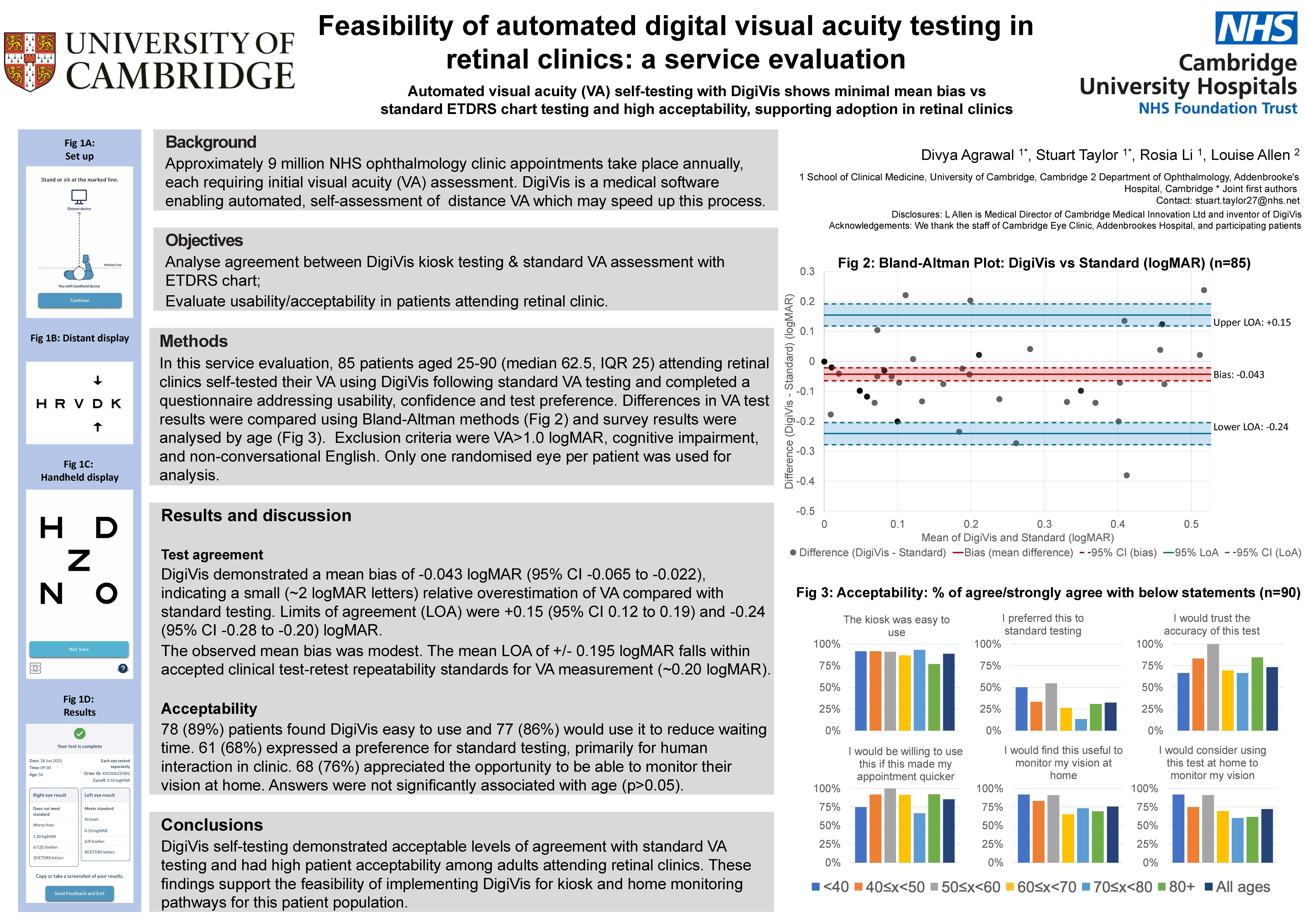 |
Feasibility of automated digital visual acuity testing in retinal clinics: a service evaluation
Agrawal D, Taylor S, Li R, Allen LE Poster: Cambridge Eye Trust Reserach Day 2026 |
Initial pilot and service evaluations of eye+dot
 |
Assessment of eye+dot for Urgent Eyecare Triage.
Dr Aaron Goldberg, Miss Louise Allen & Ms Tekla Rosell. Presented at the British Emergency Eye Care Society, London 2022. In a pilot study of eye+dot, 93 patients attending the emergency department or emergency eye clinic completed eye+dot. 97% rated the experience as good or excellent. Subsequently, 46 patients attending an emergency eye clinic completed eye+dot. 96% of eye+dot diagnoses were correct and showed a moderate correlation with a consultant's prioritisation. Patients took and average of 5.5 minutes to complete the questionaire and 93% rated the experience as good or excellent. |
 |
Initial service evaluation
of an online triage tool for urgent eye conditions.
Nisha De Souza, Lukas Helfinger, James Howard Dicks, George Nishimura, Louise Allen. Poster presentation at the Royal College of Ophthalmologists Congress, Birmingham 2023. eye+dot recommendations were compared to gold-standard triage disposition in 128 ED patients. Red or painful eye was the commonest cause for attendance (46%). Gold-standard triage disposition was urgent hospital care for 82 patients (63%). Sensitivity and specificity of automated triage for urgent cases was 100% and 93% respectively. Overall, concordance for appropriate service and urgency was high at 92% and 89% respectively. |
Published validation studies of eye+dot
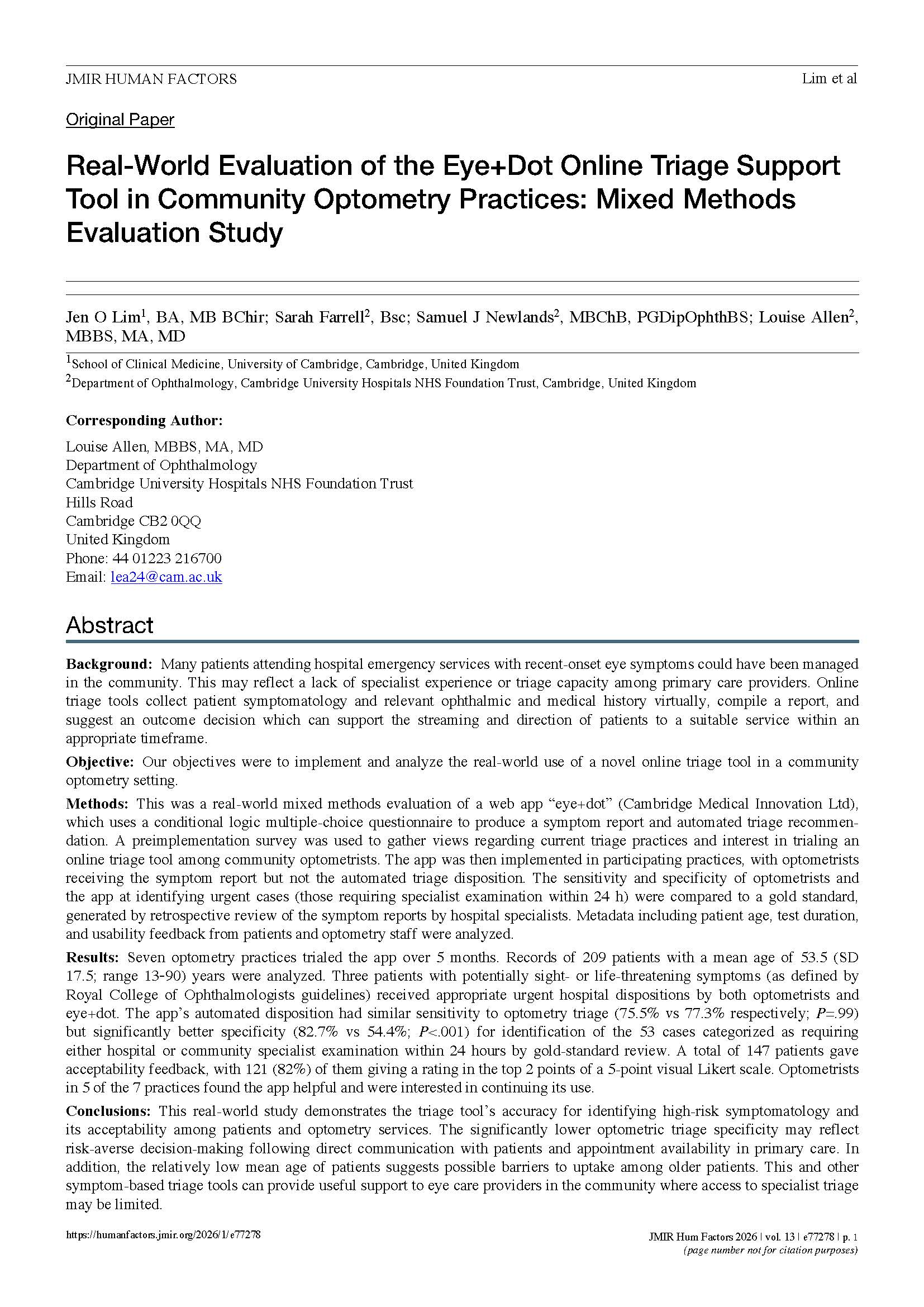 |
Real-World Evaluation of the Eye+Dot Online Triage Support
Tool in Community Optometry Practices: Mixed Methods Evaluation Study.
Lim JO, Farrell S, Newlands SJ, Allen L. JMIR Hum Factors 2026;13:e77278. Decsribes a real-world study demonstrating the accuracy of eye+dot as a triage tool for identifying high-risk symptomatology and its acceptability among patients and optometry services. Participating optometry practices asked adult patients with an eye problem to complete an eye+dot questionnaire in addition to their usual processes. The patient’s symptom report was subsequently reviewed by the clinician and forwarded as part of any onward referral. The study was intended as a first step in facilitating the development of a scalable implementation model, co-designed with the input of patients, GPs, optometrists, commissioners and secondary care teams, to create a local solution to urgent eyecare provision, which can be disseminated to promote the scaling up of adoption throughout the NHS. |
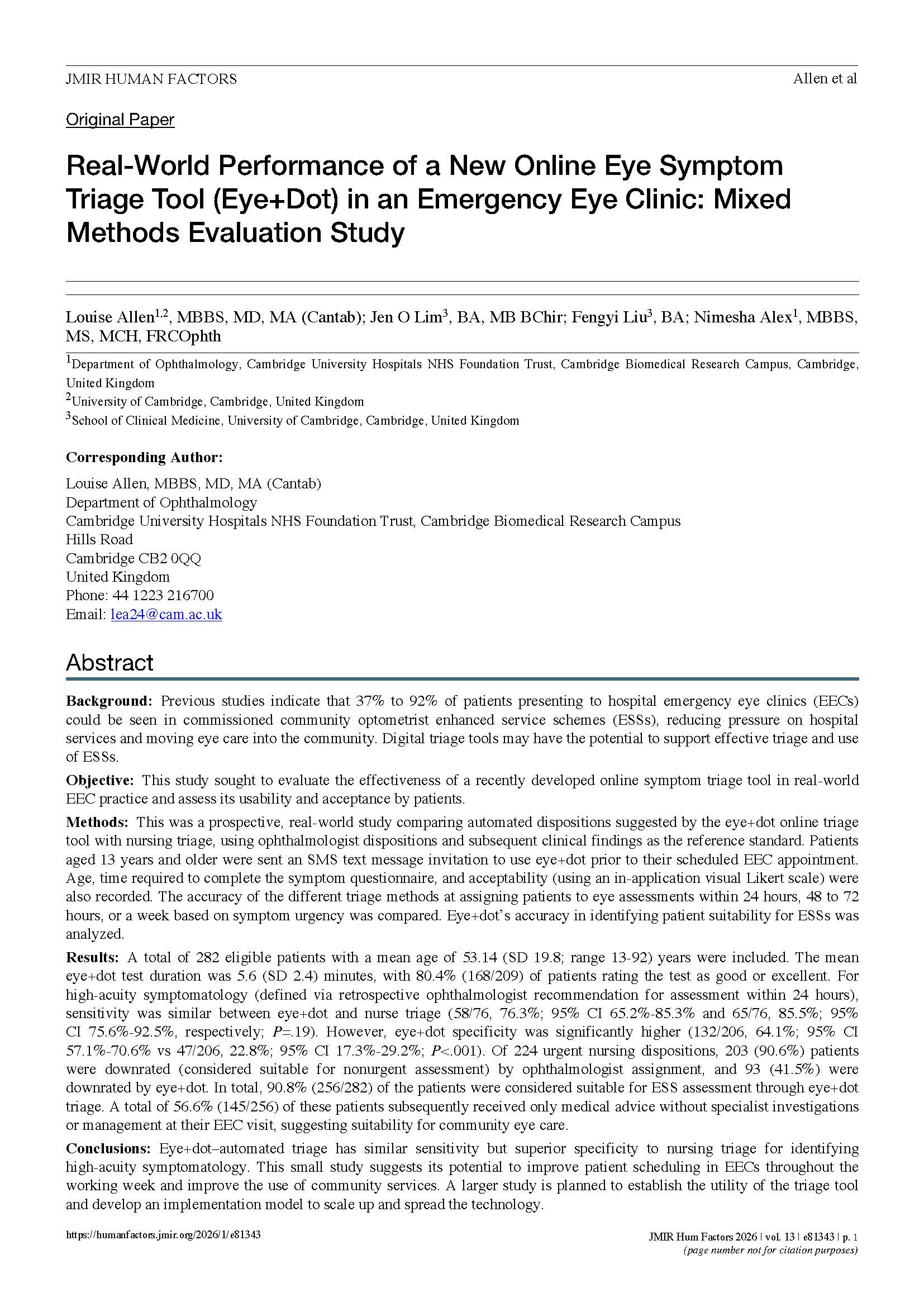 |
Real-World Performance of a New Online Eye Symptom Triage Tool (Eye+Dot)
in an Emergency Eye Clinic: Mixed Methods Evaluation Study.
Allen L, Lim JO, Liu F, Alex N. JMIR Hum Factors 2026;13:e81343. Eye+dot–automated triage has similar sensitivity but superior specificity to nursing triage for identifying high-acuity symptomatology. This small study suggests its potential to improve patient scheduling in EECs throughout the working week and improve the use of community services. |

Real-world implementation
Clinical validation is just the first step in getting a new idea adopted in a large and complex healthcare system.
We also have to ensure that the device can be successfully integrated into the processes within each organisation in a way that will enable both patients and the organisation to realise the benefits. This process of trial and feedback is critical to meet our commitment to continuous improvement.
Co-designing and evaluating a real-world implementation model for remote consultation with vision self-testing.
The ReVise study (NIHR204635).
A 30 month study in three large NHS eye departments which aims to involve the public, patients and NHS staff in co-designing a scalable, inclusive and sustainable implementation model for ophthalmic remote consultation with vision self-testing. It is estimated that over 22,000 patients with a high level of age, ethnic, cultural and socio-economic diversity will use DigiVis DVA during the study.
The data collected will be used to co-design an implementation model with stakeholders. When scaled up, disemminated and put into operation, the model could reach over 3 million patients a year and alleviate some of the pressures on UK ophthalmology services, improving patient care in the NHS and potentially improving access to eyecare and vision screening for rural communities internationally.
A 30 month study in three large NHS eye departments which aims to involve the public, patients and NHS staff in co-designing a scalable, inclusive and sustainable implementation model for ophthalmic remote consultation with vision self-testing. It is estimated that over 22,000 patients with a high level of age, ethnic, cultural and socio-economic diversity will use DigiVis DVA during the study.
The data collected will be used to co-design an implementation model with stakeholders. When scaled up, disemminated and put into operation, the model could reach over 3 million patients a year and alleviate some of the pressures on UK ophthalmology services, improving patient care in the NHS and potentially improving access to eyecare and vision screening for rural communities internationally.
